But this assumption reveals a fundamental misunderstanding
of the New Testament vision for the Church. The local church is not a
corporation to be scaled; it is a body to be nurtured. And when it comes to
spiritual formation and authentic community, the small congregation is not a
"second-best" option—it is often the most fertile ground for genuine
discipleship.
Here is why choosing to fellowship and serve in a small
congregation is not just good, but spiritually essential.
1. Get to be Known by
Name, Loved by Heart (Authentic Fellowship with a Pastor and Brethren Who Truly
Care)
In a large crowd, it is easy to hide. You can slip in five
minutes late, sit in the back, sing a few songs, listen to a sermon, and slip
out before the closing prayer. You control the narrative. You wear your
"Sunday face." In that environment, the pastor is a voice on a stage,
and the people around you are anonymous faces.
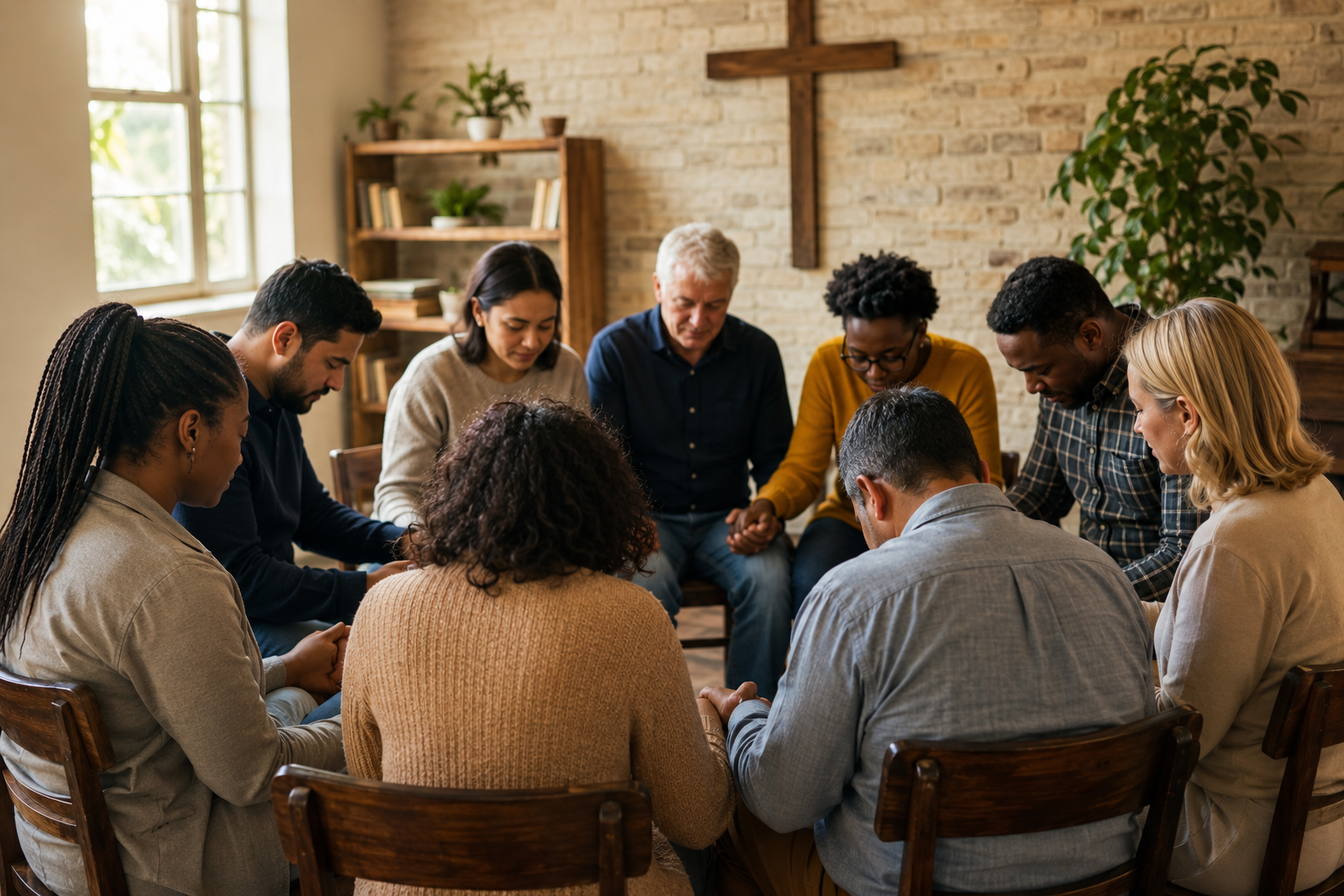
In a small congregation, everything changes. You get to
genuinely know your pastor—not just hear him preach from a distance, but sit
with him, understand his burdens, pray for his family by name, and receive his
personal shepherding when you are going through a trial. You get to know your
brethren, not as smiling strangers, but as brothers and sisters who will call
you when you are struggling, show up at your door with a meal when you are
sick, and celebrate with you when you are rejoicing.
If you are not there on Sunday, someone notices. If you are
having a bad day, someone asks—and they actually care about the answer. Small
churches force us out of the isolation of individualism and into the messy,
uncomfortable, and beautiful reality of biblical community. The Greek word for
fellowship, Koinonia, implies a deep partnership and sharing of life. You
cannot achieve Koinonia through a livestream. You achieve it when you are
standing next to the same people every week, learning their struggles, their
joys, and their quirks. In a small church, you are not a statistic; you are a
person with a pastor and a church family who truly knows and loves you.
2. No Spectators, Only Servants (The 'Loaves and Fishes' Principle
of Impactful Service)
There is a common myth that you need a massive team to make
a difference. But in the Kingdom of God, significance is rarely about numbers;
it is about obedience.
In a small congregation, there is no "spectator"
section. When the church needs a Sunday school teacher, the pastor doesn't send
out a mass email hoping someone volunteers; they look you in the eye and ask.
In a large church, your talents can easily get lost in the talent pool. Your
voice is one among a hundred in the choir. Your organizational skills are a
tiny cog in a massive machine.
In a small church, your service is visible and vital. If you
don't show up to set up the chairs, there are no chairs. If you don't teach the
class, the class doesn't happen. This isn't a burden; it is a gift. It allows
you to see the direct fruit of your labor. You get to experience the
"Loaves and Fishes" miracle—seeing how God takes your meager offering
of time and talent and multiplies it to sustain the entire body.
3. Room for Your Unique Gift (No Benchwarmers)
Scripture tells us that "each one of us has been given
a gift to be used for the Kingdom" (1 Corinthians 12:7). But in a
mega-church, many ministries are already fully staffed. The worship team has
enough singers, the children's department has enough teachers, and the tech
booth has enough operators. If you walk in wanting to serve, you may be placed
on a waiting list or given a token role that barely uses your actual talents.
The small congregation is completely different. There, your
specific gift—whether it is hospitality, administration, teaching, music,
mercy, or encouragement—is not just a "nice addition"; it is a vital
necessity. In a small church, there are never "enough" ministers.
There is always a gap that needs filling, and your unique ability might be the
exact answer to a prayer that the pastor or the ministry lead has been praying
for.
In a large church, you are a spectator watching
professionals do ministry. In a small church, you are a participant—and the
body of Christ cannot function fully without your specific contribution. It is
the place where you get to discover, refine, and deploy your gifts in
real-time, rather than watching others use theirs from the pew.
Conclusion: Committing, Not Consuming
Our culture is obsessed with "I"—my preferences,
my comfort, my growth. We church-hop looking for the perfect worship style or
the best kids' program. We treat the church as a consumer product.
Yet, this decision must not be made casually. It is crucial
to prayerfully choose the right congregation—a spiritual home where you can
genuinely fellowship, be nourished by sound doctrine, and grow in your walk
with Christ. This is especially vital in these end times, where many are being
swept away by deceptive waves of false teaching, worldly compromise, and
spiritual distraction. Without a committed, rooted church family, it is easy to
drift.
The small church is not a stepping stone to a bigger one; it
is a destination. It is the soil where roots go deep, where fruit is born, and
where the love of Christ becomes tangible in the flesh and blood of the people
sitting right next to you. To fellowship and serve there is to embrace the
heart of God—who chose the small, the weak, and the humble to shame the mighty.